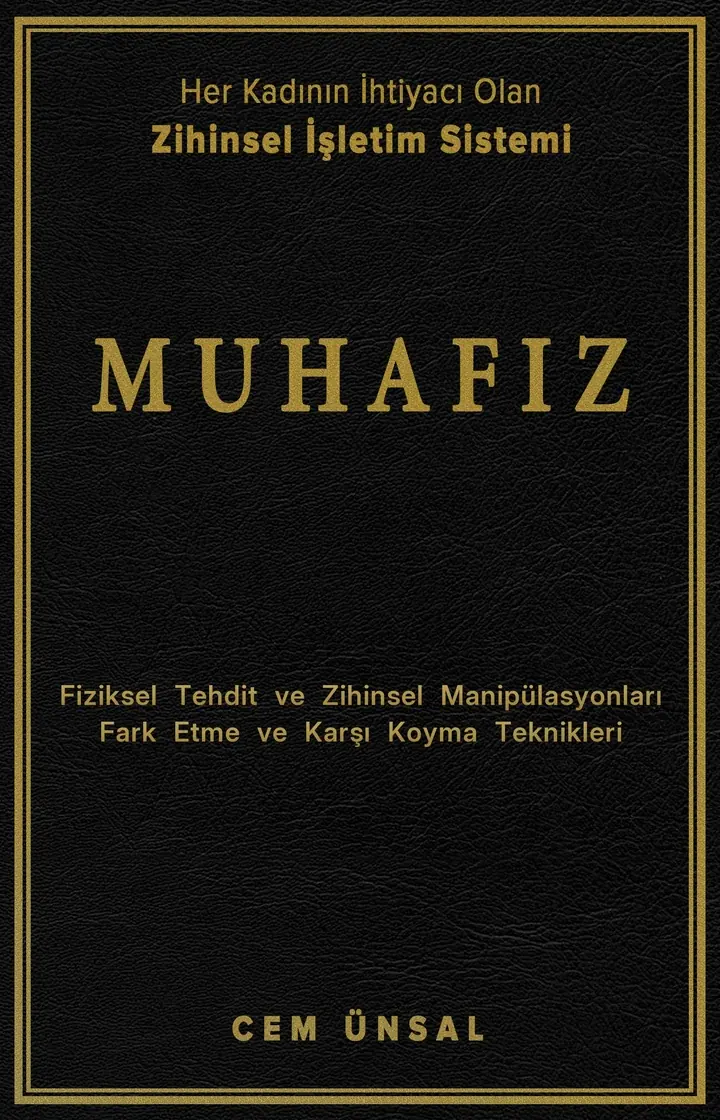
Muhafız

For Women · A Practical Guide to Mental Architecture and Safe Living

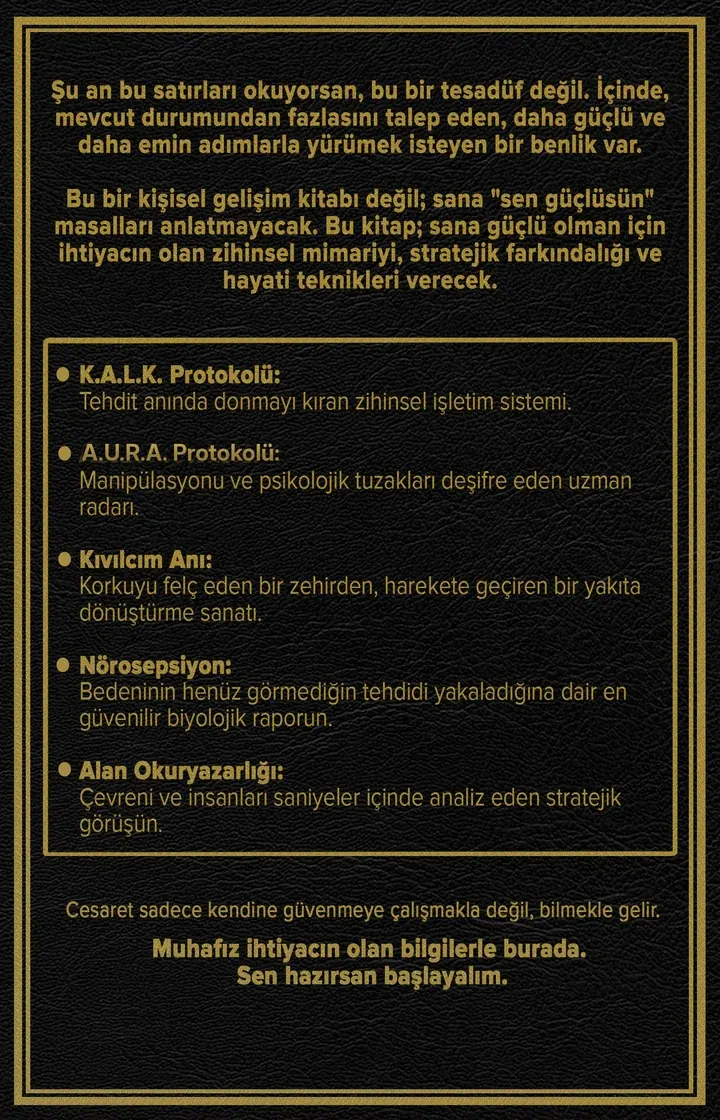
If you are reading these lines right now, it is no coincidence. There is probably a self inside you that asks for more than where you are now, one that wants to walk with stronger, surer steps.

Maybe you know that uneasy feeling that makes you hold your breath when you are alone in an elevator with a stranger. Or maybe you are tired of the fake smile you had to put on “so as not to be rude”, even though a look made you uncomfortable.

For years you were taught that the unease you feel is called “fear” or “paranoia” and that you should push it down. Here we will do something different.
From the foreword of Muhafız, translated from Turkish

This book was written for the woman who finds herself in one of the scenes below.

The book does not describe women by type but by lived moments. Every scene below comes from inside the book, and every one of them was lived.

01
If you hold your breath when you are alone in an elevator with a stranger.
“You know that uneasy feeling that makes you hold your breath.”
Foreword
02
If you put on a fake smile “so as not to be rude” even though you feel uncomfortable.
“Even though a look made you uncomfortable… you are tired of the fake smile you had to put on your face.”
Foreword
03
If, when your intuition senses something, a voice inside tells you “you’re overreacting”.
“You’re overreacting… You got it wrong… Don’t spoil the mood now, don’t ruin everyone’s fun.”
Chapter 3 · The Unbreakable Mind
04
If you tell yourself “I must be misreading this” when it feels like someone is following you.
“Instead of stepping into a shop, you tell yourself ‘I must be misreading this’ and keep walking home in fear.”
Chapter 3 · The Unbreakable Mind
05
If you smile to keep the peace when someone stands closer to you than they should.
“Your body tenses, but you put on a fake smile so as not to spoil the mood.”
Chapter 3 · The Unbreakable Mind
06
If saying “no” still feels like a crime and leaves you embarrassed every time.
“You were taught to feel ashamed even as you said ‘no’. Be good. Don’t raise your voice.”
Chapter 3 · The Unbreakable Mind
07
If a partner silences you with “you’re too sensitive, you’re being paranoid”.
“You’re too sensitive, you’re being paranoid, you blow everything out of proportion.”
Chapter 6 · Invisible Signals
08
If someone who called you their “soulmate” asks you, a few weeks later, to stop seeing your friends.
“I gave up everyone for you, so you should stop seeing that friend of yours.”
Chapter 6 · Invisible Signals
09
If your stomach ties itself in a knot when you are punished with the silent treatment.
“My stomach is in knots and I feel the urge to do anything to break this silence.”
Chapter 10 · Defending Your Space and Boundaries
10
If you want the ground to swallow you up when a partner humiliates you in front of your family.
“It was as if boiling water had been poured over me… I wanted the ground to swallow me up with shame.”
Chapter 10 · Defending Your Space and Boundaries
11
If your partner “suddenly” falls ill every time you make plans of your own.
“Just as I was about to leave the house, with a pale face: ‘Please stay with me tonight, I really need you.’”
Chapter 10 · Defending Your Space and Boundaries
12
If you have a child and quietly dread the day you may have to protect them.
“A mother does not think when her child is in danger. She simply acts.”
Chapter 11 · Crisis Management and Protection
This book gives it a new name.

For years you were taught that the unease you feel is called “fear” or “paranoia” and that you should push it down.

But this book was not written to teach you not to be afraid. It was written to show you how to turn fear into fuel.

What you feel has real names. They are not weakness. They are your most reliable alarm system.

Neuroception
The result of millions of micro-signals your brain processes far faster than your conscious mind. A tightening in your stomach is not a “hunch”. It is a biological report.
The Fawn Response
The fourth response beyond “fight, flight, freeze”, the reflex to please the very person who threatens you. It is the neurological name for “I don’t want to be rude”. The mechanism was described by trauma specialist Pete Walker.
The Politeness Trap
The biggest breach in your firewall. In a suspicious situation you do not owe anyone politeness. Your intuition and your safety come before someone else’s comfort.
The Law of Resonance
Logic can be wrong, but the body does not lie. If your energy drains and your stomach tightens after a conversation, that relationship is toxic. Your body is the seismograph of your soul.

Six protocols. For each one, the book gives a complete game plan.

Not fine words, but named, science-based operational systems you can apply step by step.

K.A.L.K.
Core Operating System
Kabul Et · Algıla · Lehine Çevir · Kalk (in English, R.I.S.E.: Recognize, Interpret, Seize, Elevate). The mental operating system that pulls you out of freezing and into action in a moment of danger. The heart of the book.
“Freezing is a highway built by years of conditioning. This protocol opens a new road.”
Chapter 4 · K.A.L.K. Protocol
A.U.R.A.
Relationship Radar
Aim · Undercurrent · Resonance · Action. A formula for reading the other person’s intent, whether there is a cycle, and what your body is telling you.
“Ambiguity is the manipulator’s playground; clarity is your strength.”
Chapter 7 · A.U.R.A. Protocol
Knife
Emotional Swiss Army Knife
Precision File, Stabilizing Screwdriver, Surgical Scalpel. Not every problem calls for a sledgehammer. Choose your tool to fit the situation.
“A file for beginner’s mistakes. A screwdriver for those who push boundaries. A scalpel for narcissistic bonds.”
Chapter 10 · Defending Your Space and Boundaries
Warrior
Warrior Mode & Ignition
Anchor thought + physical trigger + emotional visualization. A trained reflex that cuts the freeze response down to a millisecond.
“Hollander (2014): this system reduces the risk of assault by 70%.”
Chapter 4 · K.A.L.K. Protocol
360°
Situational Awareness
Reading people, places and atmosphere like an expert. Cooper Color Codes: White, Yellow, Orange, Red.
“Paranoia is believing in what is not there; vigilance is seeing what is there as it is.”
Chapter 1 · Watchful Eyes
Legal
The Right to Self-Defense
The end of the fear “What if defending myself makes me the guilty one?” The unshakable confidence of knowing where the law protects you.
“To erase hesitation and take up your legal right.”
Chapter 12 · The Legal Protection of Your Actions

Across four parts, you build the calm strength within you, step by step.

This is not a promise. It is an outcome. Twelve chapters come together in four parts, and each part carries you one step further.

I
Building a New Mind
1 Watchful Eyes · 2 Fear, the Truest Lie · 3 The Unbreakable Mind · 4 The K.A.L.K. Protocol
NeuroceptionSpark MomentK.A.L.K.
Fear is no longer the enemy that stops you. It is the fuel that moves you. You no longer freeze.
II
Seeing the Threat, Reading the Mind
5 The Enemy’s Mind Map · 6 Invisible Signals · 7 The A.U.R.A. Protocol
Threat ScaleA.U.R.A.Boundaries
You clear away the fog of manipulation, read intent and see the game.
III
What to Do in the Field
8 Physical Resistance · 9 Safety on the Move · 10 Defending Your Space and Boundaries · 11 Crisis Management and Protection
REACTField reflexes
Even in the hardest moment you are not helpless. You always, always have options.
IV
Legal Protection and the Handover
12 The Legal Protection of Your Actions
Lawful Self-Defense
You act without hesitation, knowing your rights. You take over the watch.
Your new identityMuhafızHighly aware · Strong-willed · Calm strength

What women who read the book before its release are saying.

The test readers who read and reviewed Muhafız before its publication. Different ages, different cities. As they read, each of them found her own life in it.

Halfway through the first chapter I closed the book and cried. For years I thought “I’m overreacting”. It turns out my body was right and my mind had silenced it.
Elif · 34 · Istanbul
I practiced AURA for two weeks. The exhausting tension between my mother-in-law and me eased for the first time. It was me who needed to change, not the relationship.
Merve · 41 · Ankara
I always thought I stood on my own two feet. In the Fragile Bully chapter, three of my husband’s lines were written word for word. A cold sweat ran down my back.
Zeynep · 38 · Izmir
I didn’t know there was such a thing as the “politeness trap”. The moment I learned that name, all my friendships took on a new meaning.
Ayşe · 29 · Bursa
After my divorce I couldn’t stop blaming myself. When I read the difference between the Soulmate and the Malignant Narcissist, the voice inside me changed overnight. I’m so glad I read it.
Pınar · 42 · Izmir
The real strength of the book is that it doesn’t tell you what to do. It introduces you to your own strength. I’m a different person now.
Hande · 36 · Kocaeli
For years a male manager at work treated me as if I had no boundaries. I used the Loudspeaker Technique in a meeting. Two weeks later he apologized.
Ece · 31 · Istanbul
· Test reader feedback, translated from Turkish ·

The book’s own answers.

Won’t this book make me paranoid?
Quite the opposite. The book keeps separating paranoia from vigilance.“Paranoia is believing in what is not there; vigilance is seeing what is there as it is.”And it explains that this scanning, which feels like “work” to you now, soon becomes a quiet reflex, as automatic and effortless as breathing, running in the background.
I’m physically weak. Does resisting work?
The book answers this question with statistics.“No resistance or pleading, and the assault is completed in 93 to 96% of cases. Strong verbal resistance succeeds 44 to 50% of the time. Physical resistance, 86%. Combined strategies, over 90%.”Not resisting is statistically far more dangerous than resisting.
Who will I be when I finish the book?
“When this book ends, She will not leave. Because She is no longer knowledge from outside but a part of you, a quiet ally who is always ready and who will stay with you for the rest of your life.”
Is this combat training? Do I need physical training?
No. Most of the book is mental and psychological. The physical chapter is not about complex techniques. It gives you three simple, science-based reflexes you can use whatever your build. The goal is not to fight but to create a chance to escape.
My relationship is troubled, but there is no violence. Is this book for me?
Very much so. The second part of the book (the chapters The Enemy’s Mind Map and Invisible Signals) is devoted entirely to reading relationship dynamics and manipulation. Gaslighting, love bombing, the silent treatment, playing the victim, public execution, the devil’s advocate game. Non-physical violence is half the book.
Is the book only for women?
The book was written for women. Its subtitle is exactly “For Women · A Practical Guide to Mental Architecture and Safe Living.” Still, it is essential reading for the partner, mother, father, sibling or male friend who stands beside a woman.
You are a Muhafız now.
Surrender to fear is over.The watch is yours.

Holding your breath in the elevator. Over.

Smiling “so as not to be rude”. Over.

Silencing your intuition. Over.

Muhafız in English is coming soon

Know the day the English edition comes out. Leave your email and be among the first to hear the launch news.

Your address is used only for news of the book’s release. Privacy

Turkish edition · 364 pages · Paperback
