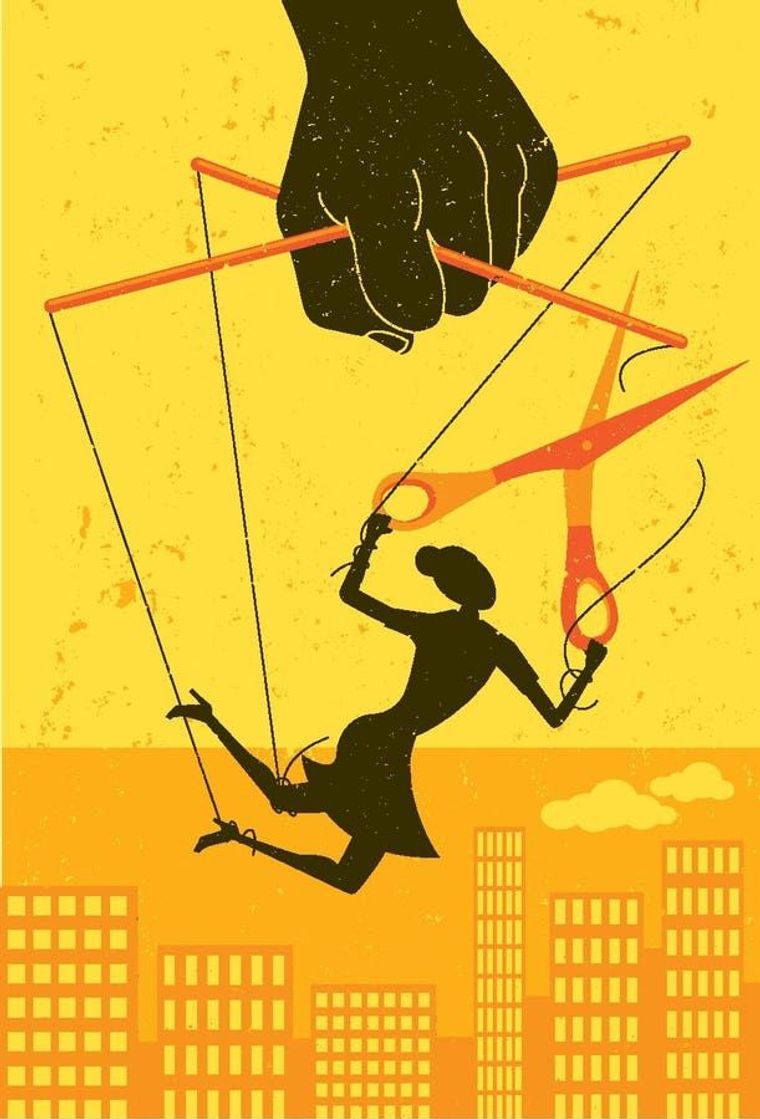
Manipulation in a relationship is a pattern of behavior that takes over your sense of reality, your boundaries and your energy without any obvious insult. Its five most common forms are gaslighting, love bombing, the silent treatment, public humiliation and the insult disguised as a "joke." All of them share one goal, to make you doubt yourself and bring you under control.
You know this feeling. Even at the moment you are most in the right, that familiar sentence surfaces somewhere in your mind, "maybe I'm overreacting." The conversation ends, but you find yourself feeling small for no reason, confused and drained.
Let me say this clearly. That feeling is not something you imagined. It is data. Your nervous system reads a pattern and sends you a signal before you can even put it into words. In this article I'll show you how to read that signal and what to do about it. The goal is not to analyze your relationship. It is to protect your own mind.
What manipulation is, and how it differs from an ordinary argument
Not every moment of tension is manipulation. Healthy relationships have arguments too, hurt feelings too, misunderstandings too. What sets manipulation apart is not a single incident but a repeating cycle. A single moment of jealousy may be insecurity. A pattern that keeps repeating, that becomes constant checks on who you see, where you are and who is texting you, is no longer jealousy. It is strategy.
To make this distinction, Muhafız, my book on women's personal safety, offers a tool. It is called the A.U.R.A. Protocol (Aim, Undercurrent, Resonance, Action). A.U.R.A. is not a feeling. It is a method of reading. It works like a radar you set up in your mind whenever you face social or psychological pressure.
Here is how the four steps work. Aim asks, "what is the likely driving force behind this behavior?" and moves you out of panic and into observer mode. Undercurrent asks, "is this a one-time accident or a repeating cycle?" and separates accident from strategy. Resonance asks, "whatever the intent, how is my body echoing this?" If your stomach tightens or your shoulders tense, that is data, and it is non-negotiable. Action means making your move based on those three data points, not in anger but like a chess master.
Now let's use this radar to decode the five most common moves in a manipulator's playbook.
Game 1 · Gaslighting (Reality Manipulation)
The line. Yesterday they said something hurtful to you and you argued. Today you calmly explain how much that hurt you. They stop you, look at you with a worried expression and say, "What are you talking about? I never said anything like that to you. Are you misremembering things lately? I'm worried about you."
Decoding the tactic. This is not an ordinary lie. Gaslighting is a form of psychological abuse that denies what happened so that you doubt your own memory and sanity. Its goal is not to win the argument. It is to shift the ground your reality stands on. Over time you start to wonder, "is the problem me?" That is exactly what the game is for. As Medical News Today notes, people exposed to gaslighting can develop a distorted self-perception and symptoms of anxiety.
Counter-move. Know that this is not a memory contest. You don't have to convince them. Your goal is to protect your trust in your own mind. Refuse to get drawn into the argument and take the frame back with one calm, clear sentence. "I'm surprised you remember it differently. But I know what I heard and what I felt. I'm not going to discuss this any further." This answer rejects the false reality they built and takes the power back without an argument.

Game 2 · Love Bombing (A Barrage of Excessive Attention)
The line. In the very first weeks of the relationship they keep telling you, "you're the most wonderful person I've ever met, you're my other half." They want to spend all their time with you alone, and they quickly cut you off from your social circle.
Decoding the tactic. This is not healthy love. It is an operation to create dependency. Flooding you with intense attention early on lowers your guard and quickly puts you in their debt. Then that "investment" turns into a tool of control, "I gave up everyone for you, so you can stop seeing that friend of yours." Healthy closeness is built over time. Closeness built too fast is often not a bond but an attempt to make you feel indebted. According to Psychology Today's definition, love bombing is a manipulative tactic that uses a display of excessive attention and admiration early in a relationship to make a partner dependent and take control.
Counter-move. Read this sudden intensity not as a declaration of love but as a speed test. Your strongest move is to slow things down. "We'll understand each other better as we get to know each other. I believe moving slowly and steadily is healthier in a relationship." This sentence makes your pace the rule, not theirs. Setting your boundary here closes the door they were using for isolation and control.

Game 3 · The Silent Treatment (Punishment by Absence)
The action. You tell them you've made dinner plans with your friends, without them. Their face falls. That evening and the next day they don't speak to you, they answer your messages hours later with one-word replies, and in the same room they act as if you aren't there.
Decoding the tactic. This is not innocent sulking. Punishment by absence is a control tactic that makes you suffer "social pain" by sulking, going silent and ignoring you whenever you don't do what they want. By depriving you of love and attention, it creates tension so intense that you agree to cancel your plans and apologize just to make the pain stop. You are not the source of the pain. They are the one using it as a lever.
Counter-move. Know that this is not a feeling but a tactic. The way to defuse it is to honor your own presence, not their absence. Don't panic and cancel your plans, and don't keep asking "what's wrong?" Get ready calmly, go ahead with your plan and enjoy your time with your friends. This takes away their strongest weapon, your panic, and shows that their behavior cannot stop your life. Staying dull and unresponsive in the meantime, without chasing any emotional exchange with them, is called the grey rock method. It starves the manipulator of energy.

Game 4 · Public Execution
The line. You're at a family dinner. Your mother compliments your dress. Your partner cuts in and, with a mocking laugh, announces to the whole table, "Mom, you should see her closet! I saw her credit card statement this month, she spent a small fortune. Sometimes you have to rein her in!" The room goes ice cold.
Decoding the tactic. This is not an innocent joke. Public execution is an attempt to damage your standing by exposing your most private matters in front of others under the mask of a "joke." It turns your most intimate information into a weapon, in front of the people you care most about, to humiliate you and establish authority over you. The goal here is not humor. It is to announce who calls the shots at this table.
Counter-move. There is no room for a gentle warning in this scenario. End the game immediately and clearly. Don't address everyone at the table. Look straight into their eyes, without raising your voice but in an ice-cold tone. "Talking about our private matters, especially money, in front of our families like this is out of line. It embarrasses me. I'm ending this conversation here." This answer tears through the "joke" illusion, names the behavior and takes the power back without entering an argument. I call this a Boundary Declaration, naming the behavior that bothers you in clear language, no matter how they defend it.
Game 5 · The Insult Behind "I'm Just Joking"
The line. They say something hurtful to you on purpose. The moment you show you're hurt, they go on the defensive, "Oh, come on, I was joking, don't you have any sense of humor? You're so touchy!"
Decoding the tactic. This is a tactic to invalidate both you and your justified reaction. The real goal is to test your boundary and clear themselves by making you look "oversensitive." The "I'm just joking" mask is often the start of perception management. The manipulator's second favorite move here is Playing the Victim. Instead of facing their own behavior, they say "I'm the one who's really hurt" and shift the responsibility onto you.
Counter-move. The perpetrator's intent is not your problem. The effect the behavior has on you is your reality, and that is data. Don't get into an argument. Draw the line calmly and clearly. "I don't find jokes like that funny," or "I didn't like that comment." Don't make a request here. State a decision. Not "please don't," but "I don't want comments like that made in front of me." This is called a Decision Statement. If they do it again, repeat the same sentence with the same calm. Don't pile on explanations, just repeat it. This is called the broken record technique.
How to read the intent behind a behavior · 4 Relationship Archetypes
Not every boundary violation carries the same weight. Telling whether the intent behind a behavior is clumsiness, deep fear or deliberate malice lets you calibrate your response correctly. Muhafız describes four partner profiles, the ones the Aim step of the A.U.R.A. Protocol points you toward.
- The Soulmate. A responsible, secure partner. Respects your independence, can face their own mistakes, values your boundaries. The exact opposite of the manipulation list.
- The Clumsy Communicator. Not malicious, simply never learned how to communicate. Crosses boundaries by accident but does not cause deliberate harm.
- The Fragile Bully. Their behavior comes from insecurity, not malice. They try to control because they are afraid.
- The Malignant Narcissist. Deliberate and strategic. No empathy, no remorse, no intention to change. The most dangerous of the four.
Here again, the Undercurrent step of A.U.R.A. does the work. Anyone can say the wrong thing once. What matters is the pattern. One lie is a mistake. Constant lying is character.
Calibrate your response · The Emotional Swiss Army Knife
Answering every situation with the same force is also a mistake. If you approach a Clumsy Communicator and a Malignant Narcissist in the same tone, you end up being unfair and wasting your strength. In Muhafız this is called the Emotional Swiss Army Knife, a toolkit of graded responses.
- Precision File. A gentle warning. For pointing out a beginner's mistake, an unintentional boundary violation.
- Stabilizing Screwdriver. A firm stance. For someone who keeps pushing the boundary, to fix it back in place, firmly and repeatably.
- Surgical Scalpel. The last tool. The decision to cut an unsustainable bond, one no longer worth its cost, out of your life.
You choose the right tool with the data A.U.R.A. has gathered, not with panic. A Clumsy Communicator and a Malignant Narcissist do not deserve the same tone. You don't have to answer every situation with a nuclear weapon. The wisest move is usually the most calibrated one.
All of this has a name · Self-Sovereignty
These five games, four archetypes and the four-step radar share a single goal. That goal is not to diagnose what is wrong in your relationship. It is to keep the ground of your reality, your boundary and your decision in your own hands. In Muhafız this is called Self-Sovereignty, seeing "no" not as rudeness but as a declaration of sovereignty that protects your own space.
Let me be clear about this too. This is a defense framework, not therapy. I am not telling you how to repair a relationship. I am telling you how to read a behavior and protect your boundary against it. If a relationship is harming you systematically, don't carry that alone. Let a professional, a counseling center or, if needed, legal support be part of the process.
To see the different faces of threat as a whole, read The 8 Faces of Threat. To understand why boundaries feel so hard, see my separate article on why you can't say no.
Remember, manipulation wins by making you doubt your own reality. Every time you set a boundary, you send that doubt back and declare once more that you are the master of your own space. The moment you start reading that quiet unease inside you not as something you imagined but as a compass, the rules of the game change. That is exactly where you begin to build your inner guardian.
Frequently Asked Questions
What are the types of manipulation in relationships?
The five most common are gaslighting (distorting your sense of reality by denying what happened), love bombing (building a fast bond through excessive attention and making you feel indebted), the silent treatment (punishing you with absence to inflict social pain), public execution (humiliating you in front of others under the mask of a "joke") and the insult hidden behind "I'm just joking." All five share a single goal, to make you doubt yourself and bring you under control.
How do I tell manipulation apart from an ordinary argument?
You tell them apart by the cycle, not by a single incident. Healthy relationships have tension and misunderstandings too. What sets manipulation apart is a pattern that repeats and keeps shrinking your space. The Undercurrent step of the A.U.R.A. Protocol exists to make exactly this distinction. One lie is a mistake, constant lying is character.
Something feels wrong but I have no concrete proof. Am I overreacting?
No, you're not overreacting. That feeling is data. Your nervous system detects a pattern far faster than your conscious mind does and sends signals to your body. A knot in your stomach or tension without a clear reason is not a "hunch." It is the result of thousands of micro-signals your brain has processed. The Resonance step of A.U.R.A. exists to read this inner echo. Logic can mislead you. The body rarely does.
How do I set a boundary with someone who says "I was just joking"?
Don't focus on the perpetrator's intent. Focus on the effect the behavior has on you. Name the behavior that bothers you in clear language. I call this a Boundary Declaration. Then, instead of making a request, state a decision. Not "please don't joke like that," but "I don't want comments like that made in front of me." If they do it again, repeat the same sentence with the same calm. This is called the broken record technique. Clarity is more powerful than raising your voice.
Is my partner's behavior malicious, or just clumsy?
To make this distinction, the Aim step of the A.U.R.A. Protocol looks at four partner profiles. The Soulmate (secure), the Clumsy Communicator (not malicious, just clumsy), the Fragile Bully (controls out of fear) and the Malignant Narcissist (deliberate and strategic). You read intent from how often a behavior repeats, not from a single incident. Then you calibrate your response to match. You don't approach a Clumsy Communicator and a Malignant Narcissist in the same tone.